Every day, people across the United States get arrested for something called disorderly conduct.
It is one of the most common charges in the country.
But many people do not know what it really means or how it works.
This article will explain disorderly conduct in plain words.
You will learn what it is, what counts as disorderly conduct, and what can happen if you are charged with it.
Definition and Meaning
Disorderly conduct is a legal term. It means acting in a way that bothers or upsets people in public. It can also mean acting in a way that causes a threat to public safety or peace. Most states in the U.S. have laws against it.
In simple terms, disorderly conduct is when a person acts in a way that is seen as rude, violent, loud, or harmful in a public space. This can include fighting, yelling, using bad language in public, or doing things that make other people feel unsafe or bothered.
The exact meaning of disorderly conduct can change depending on what state you are in. Each state has its own laws. But in most places, the law covers three main things: behavior that disturbs the peace, behavior that causes alarm to others, and behavior that creates a risk of harm.
Courts often describe it as a “catch-all” crime. This means it covers many different kinds of bad behavior that do not fit neatly into other crime categories. If the police see someone acting out in public but it does not match another crime, they may charge that person with disorderly conduct.
Usage and Examples
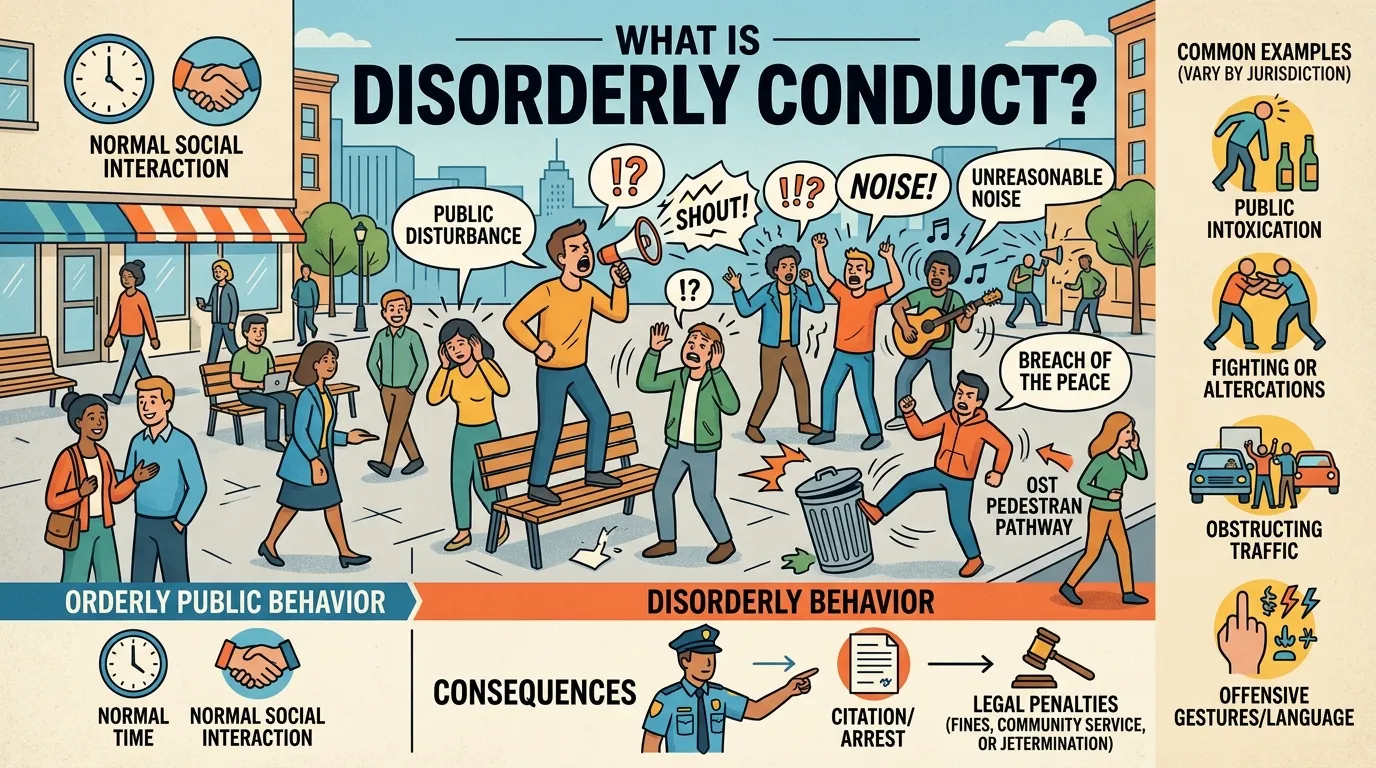
Disorderly conduct shows up in many real-life situations. It is not always about physical fights. Here are common examples of what can count as disorderly conduct in the United States.
| Type of Behavior | Example |
| Fighting or threatening | Getting into a fist fight on the street or yelling threats at a stranger |
| Loud or disruptive noise | Playing music so loud it wakes the neighborhood late at night |
| Offensive language | Shouting very offensive or vulgar words at people in a park |
| Blocking traffic or people | Standing in the middle of a road and refusing to move |
| Public intoxication | Being drunk in public and causing a scene or being out of control |
| Indecent exposure | Taking off clothes in a public space and scaring or upsetting others |
| Rioting or inciting a riot | Starting or helping to start a violent crowd situation |
| False alarms | Calling 911 with a fake emergency or pulling a fire alarm for no reason |
Think about this situation: Two people start arguing in a shopping mall parking lot. One person starts shouting very loudly and gets in the other person’s face. Even if no one gets hit, police can step in. That loud, threatening behavior in a public space is a clear example of disorderly conduct.
Another example: A group of teens play loud music and yell outside a library at midnight. Neighbors call the police. Even though no fight happened, the noise and disturbance can lead to a disorderly conduct charge.
One more: A person at a sporting event gets very drunk, starts cursing loudly at other fans, and shoves someone. This person could be charged with disorderly conduct and even assault.
Common Contexts and Applications
Disorderly conduct charges come up in many different settings. Knowing these can help you understand where and when the law applies.
Protests and public events are one big area. If a protest turns violent or someone in a crowd starts yelling threats or attacking others, police can use disorderly conduct laws to make arrests. In some cases, even peaceful protesters have been charged if they blocked traffic or refused to follow police orders. This is a very debated use of the law.
Bars and nightlife are another common setting. When people drink and get into arguments or fights outside bars, police often respond. Many disorderly conduct arrests happen late at night near bars, clubs, or concerts.
Schools and colleges also see these issues. Students who disrupt class or act aggressively on campus can face charges. Some schools also have their own disciplinary systems that mirror disorderly conduct rules.
Domestic situations that spill outside are common too. If a couple’s argument moves outside and becomes loud or physical, neighbors may call the police. Even without an actual fight, the public disturbance can lead to a charge.
Social media and online behavior is a growing area. Some states have started using disorderly conduct laws to deal with online harassment that causes public fear or panic. This is still evolving in the courts.
As a legal charge, disorderly conduct is usually a misdemeanor. A misdemeanor is a smaller crime than a felony. It often carries punishments like fines, community service, probation, or up to one year in jail. But if the conduct is very serious or involves weapons, it can become a felony charge. A felony carries bigger punishments, including more than one year in prison.
Similar Terms or Alternatives
Disorderly conduct is related to several other legal terms. Knowing the differences can help you understand what you are dealing with if you are ever in a legal situation.
Breach of the peace is one of the closest related terms. It means the same kind of thing. Disturbing the peace or breaching the peace refers to behavior that interrupts the calm of a community. Some states use this term instead of disorderly conduct. In some places, both terms exist and are used for slightly different situations.
Public intoxication is sometimes charged along with disorderly conduct. Being drunk in public is illegal in many states, even if you are not acting out. But if a drunk person causes a scene or bothers others, disorderly conduct is the more likely charge.
Harassment is another related term. When disorderly conduct involves targeting a specific person with threats or frightening behavior, it can cross over into harassment or even stalking charges.
Assault and disorderly conduct can go together. Assault means threatening someone with harm. Disorderly conduct is broader. You can be charged with both at the same time if you threaten and disturb the peace.
Rioting is a more serious version of public disorder. It usually involves a group of people acting violently together. A person can be charged with rioting and disorderly conduct at the same time if they were part of a violent crowd.
Loitering is sometimes confused with disorderly conduct. Loitering means hanging around a place with no clear purpose, especially in a way that makes others nervous. It is usually a lesser offense than disorderly conduct.
Common Misconceptions
Myth 1: You can only be charged if you physically fight someone.
This is not true. Physical violence is not required. Simply making loud threats, using very offensive language in public, or blocking traffic can be enough for a charge.
Myth 2: Disorderly conduct is not a real crime.
It is a real crime. Even though it is usually a misdemeanor, it goes on your record. It can affect your job, housing, and even your ability to get certain licenses.
Myth 3: You have a right to say anything in public.
The First Amendment protects free speech, but not all speech. Threatening language, speech designed to cause immediate panic, or speech that is directed at a person to provoke a fight (called “fighting words”) is not protected. Courts have ruled on this many times.
Myth 4: Disorderly conduct only happens in bad neighborhoods.
It can happen anywhere. It has been charged at school board meetings, in suburban neighborhoods, at airports, and even inside government buildings.
Myth 5: Police cannot arrest you unless someone makes a complaint.
Police can charge you with disorderly conduct based on their own observation. They do not need a victim to file a complaint first.
FAQs
Q1: Is disorderly conduct a felony or misdemeanor?
In most states, it is a misdemeanor. It can become a felony if weapons are involved or harm is serious.
Q2: Can disorderly conduct charges be dropped?
Yes. Charges can be dropped if there is not enough evidence or if a lawyer argues the case well. First-time offenders may get diversion programs.
Q3: Does disorderly conduct go on your permanent record?
Yes. It shows up in background checks for jobs and housing. Some states allow expungement after some time.
Q4: Can you be charged on private property?
Usually no, but some states allow it if the behavior could be seen or heard by the public.
Q5: What are the penalties?
Fines from $100 to $1,000, community service, probation, or up to one year in jail for a misdemeanor.
Q6: Can a minor be charged?
Yes. Minors go through juvenile court. Punishments are lighter but the record can follow them into adulthood.
Q7: Does it affect immigration status?
It can. Non-citizens may face visa or green card problems. In some cases it can lead to deportation. Always talk to an immigration lawyer if charged.
Conclusion
Disorderly conduct is a common but serious charge. It covers a wide range of public behaviors that disturb others, cause alarm, or threaten public peace.
It can involve fighting, loud noise, offensive language, blocking traffic, or other disruptive actions. While it is usually a misdemeanor, it goes on your record and can have real effects on your life.
Every state has its own version of this law. What counts as disorderly conduct in one state may be handled differently in another.
If you or someone you know is charged with disorderly conduct, the best move is to contact a qualified attorney as soon as possible. Understanding your rights and options early can make a big difference in how the case turns out.

My name is Maya Angelou, and I am the creator of Meaningg.com. I am passionate about sharing knowledge, meanings, and useful information with readers around the world. Through Meaningg.com, I aim to make learning simple, engaging, and accessible for everyone. I enjoy researching, writing, and helping people discover the meaning behind words and ideas.