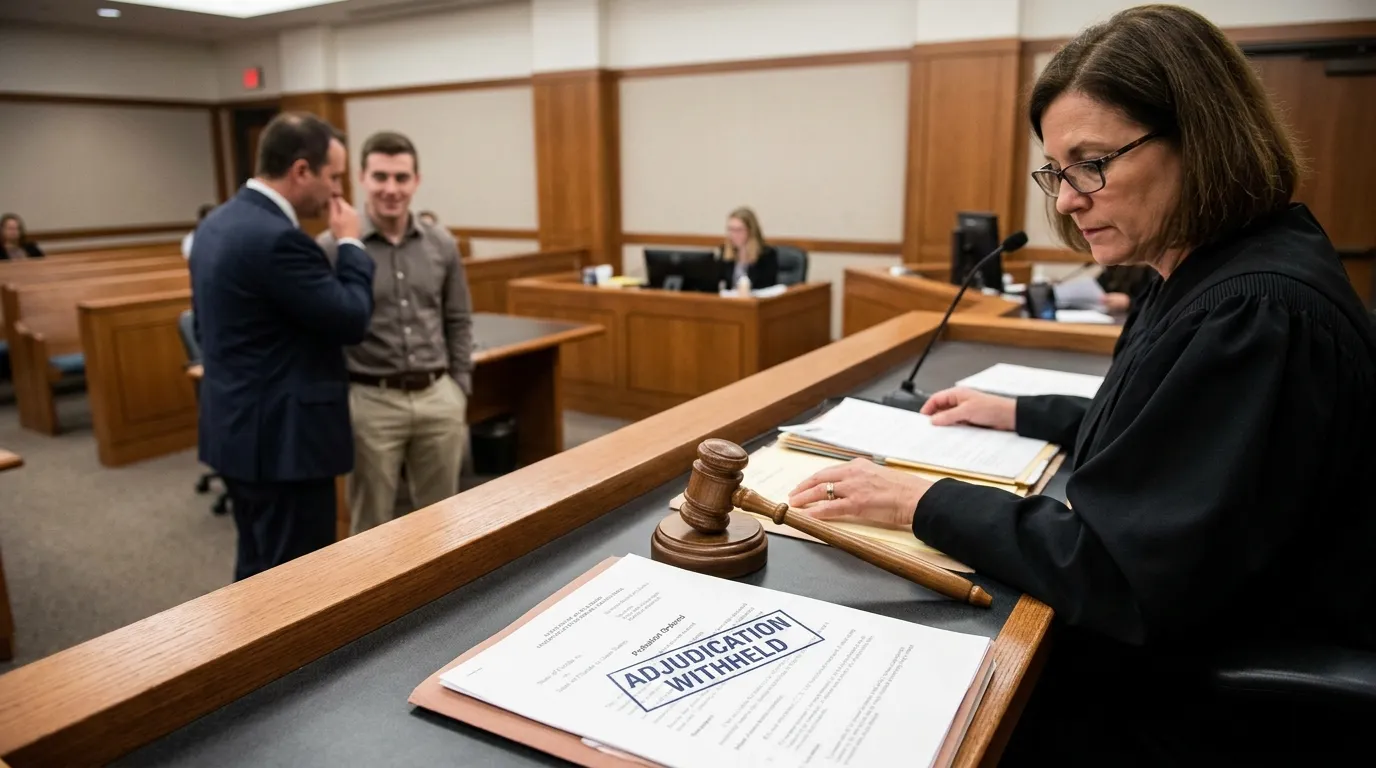
If you have seen the phrase adjudication withheld on a court record, you may wonder what it means.
This legal term can be confusing, especially if you are not familiar with court procedures.
In simple words, adjudication withheld means a judge decides not to formally convict a person, even after the person pleads guilty, no contest, or is found guilty.
Instead of entering a conviction, the judge withholds it. This can help a person avoid some of the effects that come with having a criminal conviction on their record.
Many people first hear this term when dealing with traffic cases, misdemeanor charges, or other criminal matters.
Understanding what adjudication withheld means is important because it can affect jobs, housing, education, and other parts of life.
This guide explains the meaning of adjudication withheld, how it works, where it is used, and what it may mean for your future.
Definition & Meaning
Adjudication withheld is a legal outcome in which a judge chooses not to enter a formal conviction against a defendant.
The word adjudication means a legal judgment or decision made by a court. When adjudication is withheld, the court delays or avoids entering a conviction even though the person may have admitted guilt or been found guilty.
This does not mean the case never happened. The court record still shows that the case existed. However, the person is not officially convicted of the offense.
In many cases, the judge may place the person on probation, require community service, order classes, or impose other conditions. If the person follows all court requirements, they may avoid having a conviction on their record.
The exact rules depend on the state and the type of offense. Some states use adjudication withheld more often than others.
For example, imagine a person is charged with a minor offense. They plead no contest, and the judge decides to withhold adjudication. The judge orders six months of probation. If the person completes probation successfully, the case may end without a formal conviction.
This outcome is often viewed as more favorable than a standard conviction.
| Term | Meaning |
| Adjudication | The court’s formal judgment |
| Withheld Adjudication | No formal conviction is entered |
| Conviction | The court officially finds the person guilty |
| Probation | Court supervision with specific rules |
Usage and Examples
The phrase adjudication withheld is mainly used in criminal court cases. Judges may use it when they believe a person deserves a second chance or when the offense is less serious.
For example, a college student with no criminal history may get adjudication withheld after a first-time offense. Instead of receiving a conviction, the student completes probation and stays out of trouble.
Another example involves a driver charged with a minor offense. The judge may withhold adjudication if the driver completes a traffic course and follows all court orders.
Employers, landlords, and licensing boards sometimes see this term during background checks. Because laws vary, different organizations may treat adjudication withheld differently.
Here are some sample sentences:
- The judge granted adjudication withheld after the defendant completed community service.
- The court record shows adjudication withheld rather than a conviction.
- She received probation with adjudication withheld for a first-time offense.
- The attorney explained that adjudication withheld could help avoid a formal conviction.
In everyday conversation, people may say, I got adjudication withheld, meaning the court did not enter a conviction against them.
Common Contexts and Applications
Adjudication withheld is often used in situations where a judge believes a conviction is not necessary. It is commonly seen in first-time offenses, non-violent crimes, and cases where rehabilitation is more important than punishment.
One common context is probation. A judge may withhold adjudication and place the defendant on probation. During probation, the person must obey court rules. These rules may include reporting to a probation officer, staying out of legal trouble, paying fines, or completing treatment programs.
Another context involves plea agreements. Prosecutors and defense attorneys sometimes negotiate agreements that include adjudication withheld. In these cases, the defendant agrees to meet certain conditions, and the court agrees not to enter a conviction.
Traffic-related offenses may also involve adjudication withheld in some jurisdictions. A driver may complete a course or pay required fines and avoid a conviction.
Young adults and first-time offenders are often the people who benefit most from this outcome. Judges may believe these individuals made a mistake and deserve an opportunity to move forward without carrying the full burden of a criminal conviction.
Even though adjudication is withheld, the case may still appear on background checks. This is an important point because many people mistakenly believe the record disappears completely.
The effect on employment, professional licenses, firearm rights, voting rights, and other legal matters depends on state law. Because rules vary, it is always wise to speak with a qualified attorney about a specific case.
Similar Terms or Alternatives
Several legal terms are related to adjudication withheld. While they may seem similar, they do not always mean the same thing.
Deferred adjudication is one of the closest terms. In some states, a defendant enters a plea, and the court delays a final judgment. If all conditions are completed successfully, the defendant may avoid a conviction.
Deferred prosecution is another similar concept. In this situation, prosecution is postponed while the defendant meets certain requirements. If those requirements are completed, charges may be reduced or dismissed.
Probation before judgment is used in some states. The court places the defendant on probation before entering a conviction.
Case dismissal is different from adjudication withheld. When a case is dismissed, the charges are dropped, and there is generally no finding of guilt.
The table below shows the differences:
| Legal Term | Conviction Entered? | Conditions Required? |
| Adjudication Withheld | No | Usually Yes |
| Deferred Adjudication | Usually No | Yes |
| Deferred Prosecution | Usually No | Yes |
| Case Dismissal | No | Not Always |
| Conviction | Yes | Sometimes |
Common Misconceptions
Many people misunderstand adjudication withheld. One common myth is that it means the person was found innocent.
This is not correct. In many cases, the person pleaded guilty, pleaded no contest, or was found guilty. The judge simply chose not to enter a formal conviction.
Another misconception is that the record disappears automatically. In reality, the case may still appear in court records and background checks.
Some people also believe adjudication withheld guarantees protection from all future consequences. This is not true. Certain employers, government agencies, and licensing boards may still consider the case when making decisions.
Another misunderstanding is that everyone qualifies for adjudication withheld. Judges have discretion, and eligibility often depends on the offense, criminal history, and state law.
Finally, some people think adjudication withheld is the same as a dismissal. These are different outcomes. A dismissal usually means the charges are dropped, while adjudication withheld means the case remains but no conviction is entered.
FAQs
What does adjudication withheld mean in simple terms?
It means a judge decides not to enter a formal conviction against a person, even though the person may have pleaded guilty, pleaded no contest, or been found guilty.
Is adjudication withheld the same as being found innocent?
No. It does not mean the person was innocent. It only means the court did not enter a formal conviction.
Will adjudication withheld show up on a background check?
In many cases, yes. The court case may still appear on a background check, depending on state law and the type of screening used.
Can I get a job with adjudication withheld on my record?
Many people do. However, employers may have different policies regarding criminal records and court cases.
Does adjudication withheld mean my case was dismissed?
No. A dismissal and adjudication withheld are different legal outcomes.
Can adjudication withheld help me avoid a conviction?
Yes. One of the main benefits is that it may prevent a formal conviction from being entered on your record.
Do all states use adjudication withheld?
No. Some states use different legal terms or procedures that serve a similar purpose.
Conclusion
Adjudication withheld is a legal term that means a judge chooses not to enter a formal conviction against a defendant. While the person may have admitted guilt or been found guilty, the court withholds the conviction and often requires probation, community service, classes, or other conditions.
This outcome can provide important benefits, especially for first-time offenders and people charged with less serious crimes. It may help reduce some of the long-term effects that come with a criminal conviction. However, it does not erase the case, guarantee a clean record, or mean the person was found innocent.
Because laws differ from state to state, the exact impact of adjudication withheld can vary. Understanding how it works can help individuals make informed decisions and better understand their legal situation.

Hi, I’m Emily Dickinson, the founder and writer behind Meaniingg.com. I created this website to help people discover the meanings behind words, names, quotes, wishes, and everyday expressions in a simple and easy-to-understand way.